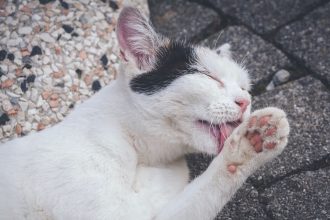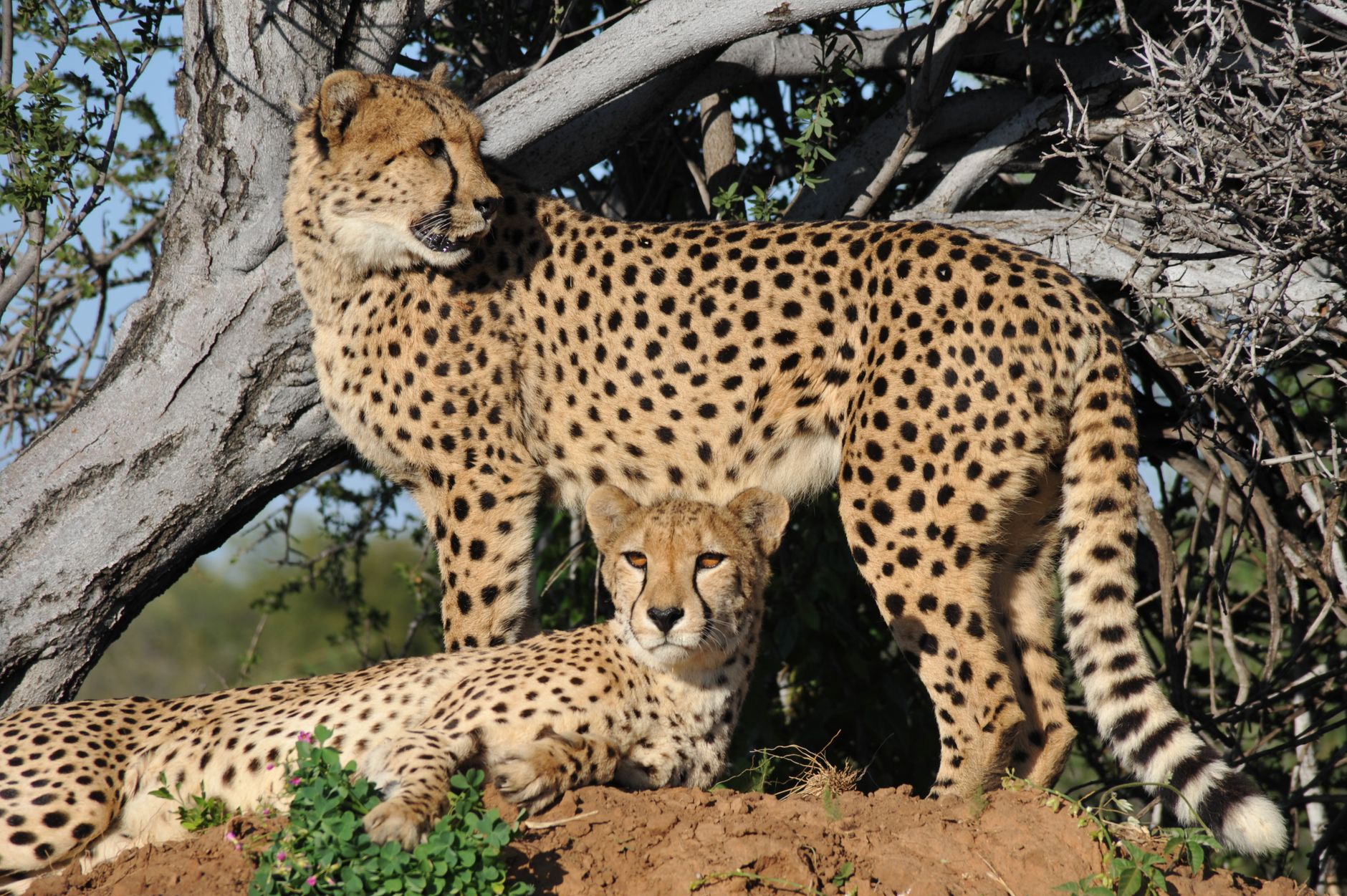
A house cat sleeping on a sofa and a cheetah sprinting across an African grassland may appear to have almost nothing in common. One is a familiar companion animal weighing only a few kilograms, while the other is a specialised predator built for extreme speed.
Despite their differences, both animals belong to the same biological family: Felidae. Their similarities are not accidental. Domestic cats and cheetahs inherited many traits from ancient feline ancestors that lived millions of years ago, although each species later evolved in very different directions. :contentReference[oaicite:1]{index=1}
The short answer: cats and cheetahs are distant relatives
Cheetahs and domestic cats are not directly related like parent and offspring. Instead, they are evolutionary cousins. Both descended from earlier members of the cat family, but their branches separated as different feline groups developed unique adaptations.
Modern cats belong to the Felidae family, which includes domestic cats, lions, tigers, leopards, jaguars, pumas and cheetahs. Scientists use genetic comparisons and evolutionary trees to determine how these species are connected.
Research comparing feline genomes shows that cheetahs and domestic cats share many genetic characteristics because they evolved from a common feline ancestor. However, they followed separate evolutionary paths for millions of years. :contentReference[oaicite:2]{index=2}
Where does the cheetah fit in the cat family tree?
The cheetah has a unique position among modern cats. Its scientific name is Acinonyx jubatus, and it is the only living species in its genus.
Unlike lions and tigers, which belong to the Panthera group of large cats, cheetahs developed along a different evolutionary branch. Genetic studies place cheetahs within the Puma lineage, which also includes the puma and jaguarundi. :contentReference[oaicite:3]{index=3}
This explains why cheetahs have several unusual characteristics compared with other big cats. Their bodies are specialised for speed rather than strength. They have lightweight frames, long legs, flexible spines and enlarged nasal passages that help support rapid acceleration and intense running.
These features make cheetahs exceptional hunters, but they also mean cheetahs are biologically different from powerful cats such as lions and tigers.
The evolutionary split between house cats and cheetahs
The ancestor shared by modern cats existed millions of years ago before different feline groups began separating. Over time, environmental pressures shaped each branch differently.
The ancestors of domestic cats evolved into smaller predators that adapted well to a variety of habitats. Eventually, one lineage produced the wildcats that are closely connected to today’s domestic cats.
Cheetahs followed another path. Instead of developing powerful bodies for fighting large prey, they evolved for high-speed pursuit. Their anatomy became specialised for chasing fast animals across open landscapes.
Genetic research suggests that the evolutionary distance between domestic cats and cheetahs is relatively short compared with many other animal groups, with some studies estimating their divergence occurred around 6.7 million years ago. :contentReference[oaicite:4]{index=4}
Why do cats and cheetahs still look similar?
Many similarities between domestic cats and cheetahs come from their shared feline heritage.
- Similar body structure: Both have flexible spines, sharp claws and muscular bodies designed for hunting.
- Predatory senses: Both rely heavily on excellent eyesight, hearing and whisker sensitivity.
- Hunting behaviour: Both species use stalking techniques before attacking prey.
- Communication: Facial expressions, body language and vocal signals are important parts of feline behaviour.
However, these shared traits have been modified differently. A domestic cat uses agility and patience to catch smaller prey, while a cheetah depends on explosive acceleration to chase animals such as gazelles.
Major differences between domestic cats and cheetahs
| Feature | Domestic Cat | Cheetah |
|---|---|---|
| Scientific name | Felis catus | Acinonyx jubatus |
| Primary environment | Homes and varied human environments | Open grasslands and savannah regions |
| Main hunting strategy | Stealth and short attacks | High-speed pursuit |
| Body design | Small and adaptable | Lightweight and specialised for speed |
| Relationship with humans | Domesticated companion species | Wild predator |
Do cheetahs have more in common with cats or other big cats?
Although people often group cheetahs together with lions and tigers because of their size, evolutionary relationships are more complicated.
Cheetahs are closer to certain smaller feline lineages than many people expect. Their closest living relatives are considered to include the puma and jaguarundi rather than the lion or tiger. :contentReference[oaicite:5]{index=5}
This is an example of why appearance alone can be misleading. Evolutionary relationships are determined by inherited genetic history, not simply by physical size or behaviour.
Why studying cheetah genetics matters
Cheetahs are also scientifically interesting because their populations have experienced severe genetic bottlenecks. Research on cheetah genomes has shown extremely low genetic diversity compared with many other mammals. :contentReference[oaicite:6]{index=6}
Understanding cheetah genetics helps scientists study conservation challenges, including vulnerability to disease and the importance of maintaining genetic diversity in endangered populations.
The same genetic research that explains how cheetahs relate to other cats also helps conservationists understand how these animals evolved and how they can be protected.
The connection between your pet cat and a cheetah
Your house cat is not a miniature cheetah, and a cheetah is not simply a larger version of a domestic cat. Their lifestyles, behaviour and physical abilities have been shaped by millions of years of different evolutionary pressures.
However, every domestic cat carries part of the same ancient feline history that produced cheetahs and other members of the cat family. Their shared ancestry explains why both animals display familiar feline characteristics: curiosity, hunting instincts, flexible movement and remarkable sensory abilities.
The next time a pet cat quietly watches something move across the room, it is displaying a small glimpse of behaviour inherited from the same evolutionary family that produced one of the fastest land animals on Earth.