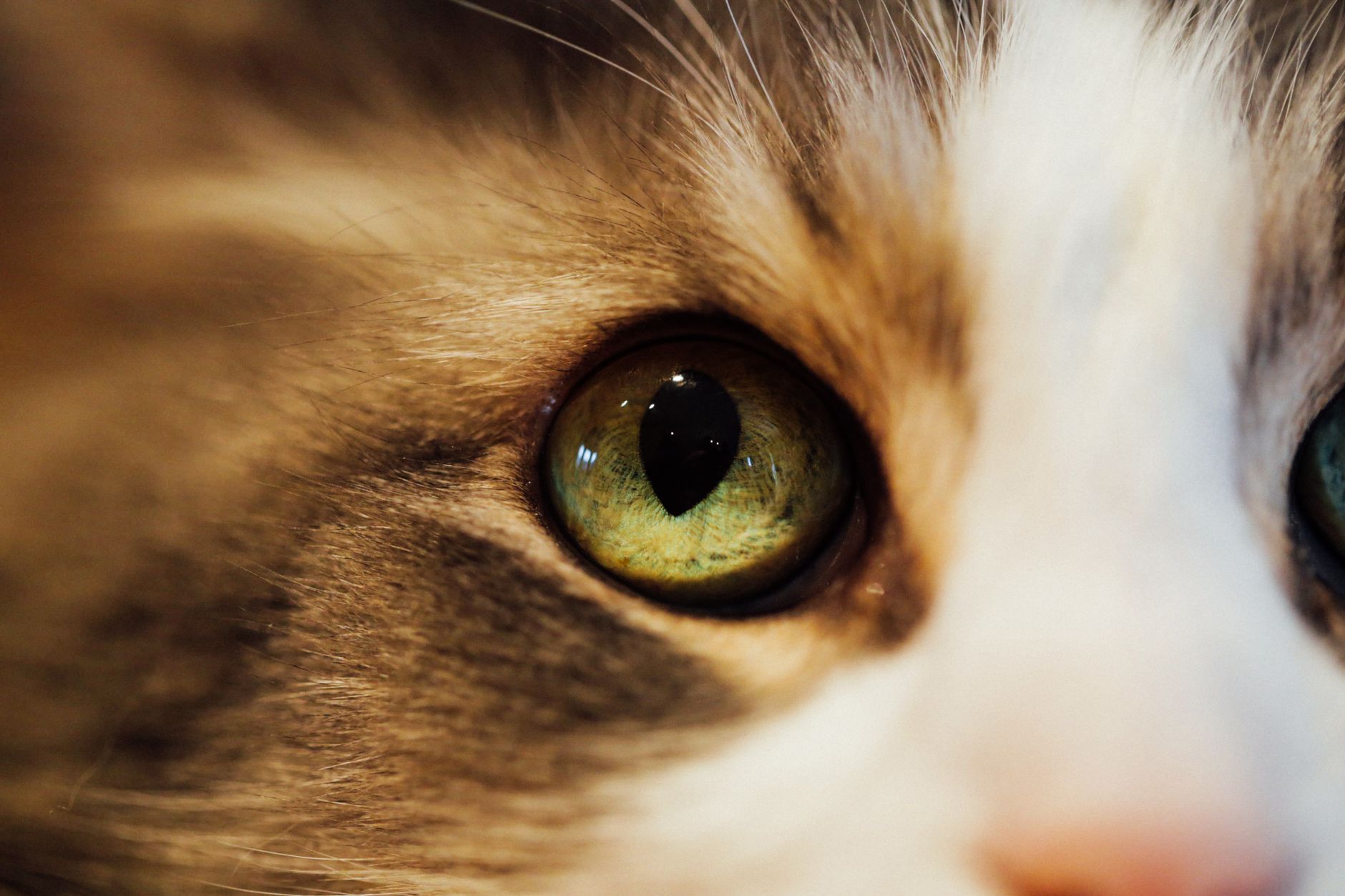
Cats do not see the world in the same way humans do. While people experience a wide range of bright colors, cats view their surroundings through a more limited color spectrum designed for their hunting needs.
A cat’s vision is not simply “black and white.” Instead, cats can see certain colors, but many shades appear less vivid compared with human vision. Their eyes are adapted for detecting movement, seeing in low light, and tracking prey rather than recognizing a broad range of colors.
The Colors Cats Are Able to See
Cats are considered dichromatic, meaning they have two main types of cone cells in their eyes that detect color. Humans typically have three types of cone cells, allowing us to distinguish a wider range of colors.
Cats can generally see:
- Blue: One of the most noticeable colors in a cat’s vision.
- Greenish shades: Cats can detect some green tones, although they may appear muted.
- Yellowish colors: Some yellow hues are visible but may not appear as bright as they do to humans.
Cats have more difficulty distinguishing colors in the red-orange range. These colors may appear grayish, brownish, or less noticeable compared with how humans perceive them.
How Cat Vision Compares With Human Vision
| Feature | Human Vision | Cat Vision |
|---|---|---|
| Color range | Broad spectrum with three color receptors | More limited spectrum with two color receptors |
| Low-light ability | Limited compared with cats | Excellent ability to see in dim conditions |
| Movement detection | Good | Highly sensitive to small movements |
| Sharpness | Generally clearer at close distances | Optimized for detecting movement and distance |
Why Cats Do Not Need Human-Like Color Vision
A cat’s eyesight developed around survival. Wild cats depend more on detecting movement, judging distance, and seeing during dawn and dusk than identifying a wide variety of colors.
For a hunting animal, noticing a small movement in grass or tracking prey in low light is often more valuable than recognizing whether something is bright red or orange.
This is why cats have visual features that prioritize:
- Motion detection.
- Nighttime visibility.
- Depth perception.
- Rapid response to moving objects.
Can Cats See in the Dark?
Cats cannot see in complete darkness, but they are much better adapted to low-light conditions than humans. Their eyes contain more rod cells, which are responsible for detecting light levels and movement.
Cats also have a reflective layer behind the retina called the tapetum lucidum. This structure helps light pass through the retina more effectively, improving their ability to see when lighting is poor.
This feature is also why cats’ eyes can appear to glow when light shines into them at night.
Do Cats Care About Color When Choosing Toys?
Because cats do not see colors the way humans do, the brightest-looking toy to a person is not always the most interesting option for a cat.
When choosing toys, other factors are often more important:
- Movement: Toys that move unpredictably often attract attention.
- Texture: Different surfaces can encourage exploration.
- Size and shape: Toys that resemble prey-like objects may trigger hunting instincts.
- Contrast: Objects that stand out from their surroundings may be easier for cats to notice.
A blue or green toy may be easier for a cat to notice than a similar red toy, but movement usually plays a bigger role in attracting interest.
How Cats See Their Environment at Home
A home that looks colorful to people may appear more muted to cats. Furniture, decorations, and toys may not stand out because many colors blend together from a feline perspective.
However, cats rely on more than color. They combine visual information with smell, hearing, and touch to understand their surroundings.
This combination of senses helps cats navigate spaces, identify familiar objects, and recognize potential threats or opportunities.
Do Cats Have Better Eyesight Than Humans?
It depends on what is being measured. Cats are not better at every aspect of vision. Humans generally see more colors and finer details, especially at close range.
Cats have advantages in areas that support hunting behavior, including:
- Detecting movement quickly.
- Seeing in dim lighting.
- Judging distances during jumps and attacks.
Their eyesight is specialized rather than universally superior.
Understanding the World From a Cat’s Perspective
Cats experience a quieter, less colorful version of the visual world compared with humans, but their vision is perfectly suited to their lifestyle. Their eyes are built for tracking, exploring, and responding to movement.
Knowing how cats see can help owners choose better toys, create more engaging environments, and better understand feline behavior. A cat may not appreciate a rainbow of colors in the same way a person does, but it notices details that humans often miss.