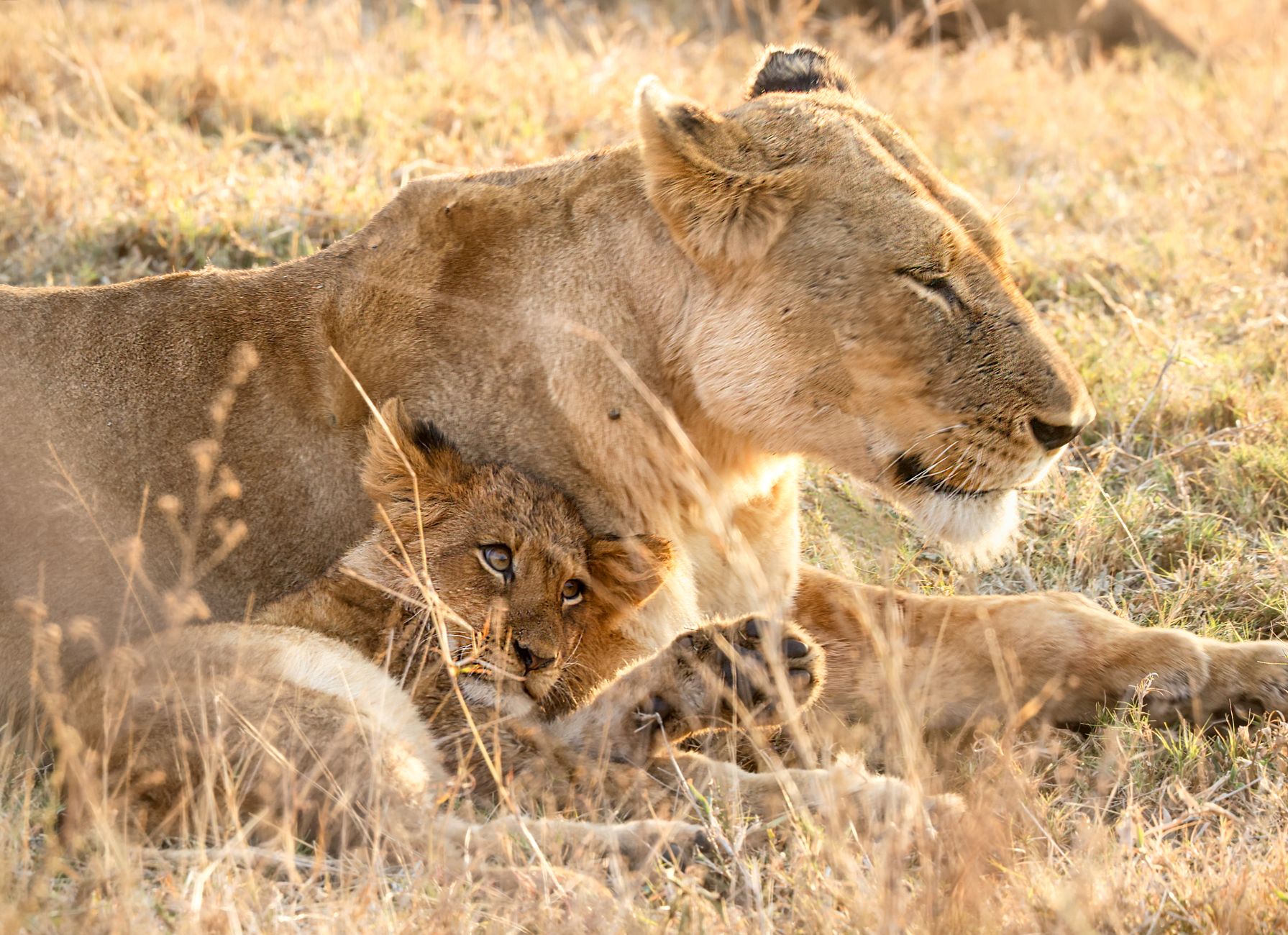
Lions and bobcats are both members of the cat family, which can make it tempting to wonder whether they could reproduce with each other. Although they share some evolutionary similarities, these two animals are separated by major biological differences that make successful mating and producing offspring impossible.
The reason is not simply their difference in size or appearance. Their genetics, reproductive biology, behavior, and evolutionary history place them on very different branches of the feline family tree.
The Main Barrier: Lions and Bobcats Are Not Closely Related Enough
Lions (Panthera leo) and bobcats (Lynx rufus) belong to the same biological family, Felidae, but they are classified into different genera. Lions are part of the Panthera group, which includes large cats such as tigers, leopards, and jaguars. Bobcats belong to the Lynx genus, which includes several smaller wild cat species.
Being in the same family does not mean two animals can interbreed. Many animals that share a distant ancestor still have enough genetic differences that reproduction is not possible.
Genetic Differences Prevent Hybrid Offspring
Successful reproduction requires compatible chromosomes and genetic information. Lions have 38 chromosomes, and bobcats also have 38 chromosomes, but chromosome number alone does not determine whether two species can create offspring.
The structure and arrangement of those chromosomes are equally important. During reproduction, chromosomes from each parent must pair correctly so an embryo can develop normally. Differences in genetic organization can prevent fertilization or cause developmental problems.
Even some closely related animals that can produce hybrids often face fertility problems or health complications. Lions and bobcats are separated by a much greater evolutionary distance, making a viable hybrid extremely unlikely.
Size and Behavior Create Additional Problems
Physical compatibility is another challenge. Adult male lions can weigh hundreds of kilograms, while bobcats are much smaller wild cats. The difference in body size would create serious practical and biological difficulties.
Their natural behaviors are also very different. Lions are highly social animals that typically live in prides, while bobcats are mostly solitary hunters. Their communication signals, mating behaviors, and social patterns developed independently over millions of years.
Even if two animals were placed in the same environment, their natural instincts would not support normal reproductive behavior.
Could Other Big Cats and Small Cats Create Hybrids?
Some feline hybrids do exist, but they usually involve species that are much more closely related. For example, lions and tigers can produce hybrids because both belong to the Panthera genus and share a relatively recent common ancestor.
Bobcats have also been studied in relation to other members of the Lynx genus, where genetic similarities are much closer. These examples show that successful hybridization is generally limited to animals with a much closer evolutionary relationship.
| Species Pair | Relationship | Hybrid Possibility |
|---|---|---|
| Lion and tiger | Both belong to the Panthera genus | Possible in some cases |
| Lion and bobcat | Different genera with significant evolutionary differences | Not realistically possible |
| Bobcat and other lynx species | More closely related within the Lynx group | Greater biological compatibility |
Why Evolution Separates Species Over Time
Lions and bobcats share an ancient feline ancestor, but their populations separated millions of years ago. Over time, each species adapted to different environments, hunting strategies, and survival challenges.
Lions evolved as large cooperative predators suited to open habitats, while bobcats developed as smaller, adaptable hunters capable of surviving across forests, deserts, and other environments in North America.
These evolutionary changes gradually created reproductive barriers. Those barriers help maintain distinct species rather than allowing unrelated populations to merge.
Could a Lion and Bobcat Live Together?
Living together and reproducing are two different issues. A lion and bobcat would not naturally encounter each other in the wild because they occupy different geographic ranges and habitats. Lions are native mainly to Africa, with a small population in India, while bobcats are found throughout North America.
In captivity, housing different wild cat species together would also present serious welfare and safety concerns. Differences in size, strength, diet, and behavior would make such an arrangement unsuitable.
The Bottom Line
A lion cannot mate with a bobcat to produce offspring because the two species are too genetically and biologically different. Although both are members of the cat family, they represent separate evolutionary paths with different body structures, behaviors, and reproductive systems.
Their shared identity as cats explains some similarities, but it does not make them compatible for reproduction. In nature, evolutionary distance plays a much larger role than simple family classification.